

Table of contents
Data plays a key role in modern life. However, little is known about where the data gets stored or how it is organized by entities. Today, many recognize a data center as the backbone of the digital world. According to a report by Statista, the projected global data center market in terms of revenue is expected to value at USD 436 Billion by 2028.
In this article, we will uncover what is a data center, their types, benefits, and how you can choose the right fit for you. Let’s take a look.
What is a data center?
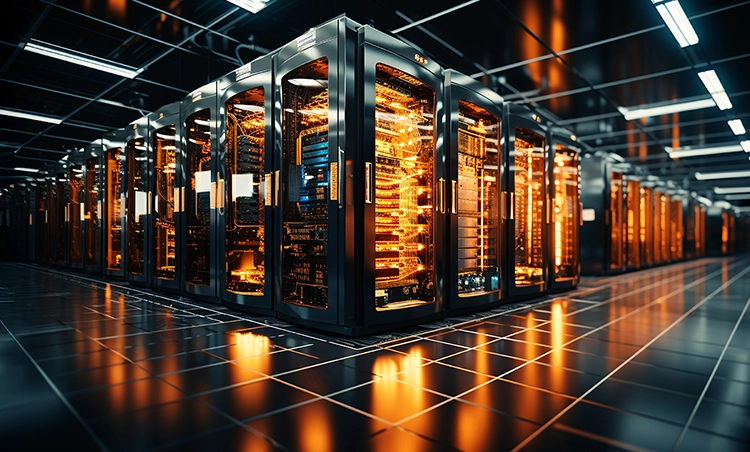
A data center is a physical facility built to store an organization’s essential applications, data, and support its IT infrastructure. It serves as a central hub where computing resources such as computing servers, storage systems, and network devices are managed, secured, and maintained. These facilities ensure that data is accessible, securely stored, and operational around the clock to support both businesses and consumers.
Data centers are meticulously designed to incorporate essential functions like advanced cooling systems that prevent overheating, and optimized rack space that support efficient hardware placement. They have massive power requirements that are supported by multiple power grid connections as well as robust UPS systems thus ensuring seamless power supply, they also have multiple redundant network connectivity for always available needs. Crucially, all these components are supported by redundant sources, ensuring failover capabilities and real-time fail-safe operations. This redundancy guarantees smooth operations even in the face of unexpected challenges, extending reliability and resilience that businesses need.
Sify’s data center network includes 16 facilities across India, with nine upcoming hyperscale and edge data centers. Its available capacity is 86+ MW, scalable to 263+ MW. Explore Sify’s data center capabilities.
Benefits of Data Centers
Data centers provide the power, cooling, security, and connectivity businesses need to run their IT systems. Colocation services also give businesses access to established facility infrastructure without having to build and operate it themselves.
Physical Security and Controlled Access
Access controls, surveillance, and visitor procedures help protect IT equipment and restrict entry to authorized personnel. These measures support physical security, while businesses still need separate controls to protect their applications, networks, and data.
Capacity to Support Growth
As businesses add applications and users, they may need more servers, storage, rack space, and power. Colocation allows them to expand within a provider’s facility, depending on available capacity and contract terms.
Sify offers rack, cage, and suite configurations for different deployment sizes. Explore its colocation services to assess options for current needs and future growth.
Support for Reliable Operations
Redundant power and cooling systems help reduce disruption when equipment fails or needs maintenance. Monitoring and operating procedures help teams identify and respond to problems.
Connections between facilities can also support data replication and disaster recovery. Businesses should assess these arrangements alongside their application recovery requirements and the provider’s service commitments. Learn more about data center interconnect services.
Network and Cloud Connectivity
Businesses need connections between their servers, offices, users, and cloud platforms. Access to multiple network providers gives them more options for designing these connections.
Sify’s data center interconnect services include cloud on-ramps to AWS, Microsoft Azure, Google Cloud, and Oracle Cloud, supporting applications distributed across colocation and cloud environments.
Infrastructure Cost Management
Building an in-house data center requires investment in space, power systems, cooling, security, and ongoing operations. Colocation allows businesses to use a provider’s facility infrastructure while retaining control of their IT equipment.
The financial benefit depends on the deployment. Compare space, power, connectivity, support, migration, and contract costs using the Total Cost of Ownership calculator.
Support for Compliance Requirements
Facility certifications, assessment reports, and service qualifications help businesses evaluate providers against their compliance and procurement requirements.
Sify lists MeitY AI & Cloud empanelment, PCI DSS, SOC 1 Type II, and SOC 2 Type II among its compliance credentials. Businesses should confirm which facilities and services these credentials cover. They support compliance assessments but do not automatically make a customer’s applications compliant.
What Are the Key Data Center Components?
Data center components work together to run applications, store information, and keep services accessible. The core components include:
- Servers: Provide the computing power needed to run business applications and process data.
- Storage systems: Hold application data, files, and backups.
- Networking equipment: Switches, routers, and firewalls connect systems and control traffic.
- Power infrastructure: Uninterruptible power supplies (UPS), backup generators, and power distribution equipment support electricity supply.
- Cooling systems: Manage heat to keep equipment within suitable operating temperatures.
- Security and monitoring systems: Control physical access and track infrastructure conditions.
Together, these components support a data center’s capacity, efficiency, and reliability. Their design and maintenance are as important as the equipment itself.
Types of Data Centers
Not all data centers are the same. Data centers differ in ownership, operating model, scale, and location. These categories can overlap. For example, a colocation facility can support high-density workloads and use energy-efficient infrastructure. Let us look at the types of data centers below:
Enterprise Data Centers
They are built, owned, and operated by a single organization. Enterprise data centers are designed to meet the specific business and IT needs of that organization and built on-premises of the enterprises who set it up.
- Pros: Enterprise data centers offer complete control over infrastructure for personalised solutions, ensuring confidential data stays within the organization. These data centers also offer scalability to meet the expanding business needs, ensuring cost predictability through investments in a fixed infrastructure.
- Cons: However, enterprise data centers come with a high initial cost of setup and require continuous maintenance.
Colocation Data Centers
In colocation data center models, firms rent a space from data center providers like Sify instead of building their own. The data center providers handle the infrastructure, including cooling, power, security, as well as provide managed services with strong SLA while the business can also choose to control its IT assets remotely or having some presence in the data center premise.
- Pros: Colocation data centers are highly cost-efficient as they come with no on-house setup. They also extend reliable performance and a relatively reduced maintenance burden.
- Cons: Recurring fees, limited control, potential downtime risks, location constraints, and provider dependency are some of the biggest drawbacks of colocation data centers.
Cloud Data Centers
These are off-premises infrastructures that are accessed by companies through the internet. Cloud data centers offer elastic options for storage and power computations, making them ideal for organizations seeking scalable, flexible capacities at a relatively attractive pay per use low-cost model.
- Pros: Cloud data centers are highly scalable, cost-effective as they come with pay-as-you-go pricing. They are also accessible from anywhere and do not require any maintenance by the user.
- Cons: Disadvantages of cloud data centers include dependence on internet connectivity, variable costs, and compliance challenges.
Hyperscale Data Centers
They are mainly for the big data driven companies because they can handle high-volume workloads. Hyperscale data centers offer scalability and operational efficiency making them unique compared to traditional data centers. All hyperscale data center providers provide various flavours of cloud services including private, public as well as hybrid cloud options and tools to manage them.
- Pros: Hyperscale data centers are cost effective for large-scale operations, and extend strong energy optimization.
- Cons: Although, hyperscale data centers have a complex management structure and offer limited customisation options.
Edge Data Centers
These smaller facilities located closer to the end-users reduce latency. Edge data centers are crucial in telecom as well IoT applications in manufacturing, pharmaceutical and many other industries, and autonomous vehicles that need real-time processing.
- Pros: One of the biggest advantages of edge data centers is that they offer low latency for faster processing, improved performance by bringing data closer to users and a better bandwidth optimization.
- Cons: Higher deployment costs for multiple locations, limited scalability, potential management complexity are some of the cons of edge data centers.
Green Data Centers
Green data centers are considered eco-friendly facilities with reduced energy consumption and lower carbon footprint. They achieve these by using renewable energy such as solar and wind energy, using energy-efficient cooling systems, and using non-toxic building materials. It is further enhanced by advancements including liquid cooling, AI-based energy management, and even waste heat recovery systems.
- Pros: Due to reduced energy consumption, green data centers have lower operational costs. Their renewable energy integration ensures long-term cost and resource efficiency.
- Cons: However, green data centers have a high upfront cost, dependency on renewable energy availability and also pose potential location constraints for sustainable resources.
Sify reports more than 300 MW of contracted green energy and IGBC Platinum certifications for its Mumbai 03, Noida 02, and Chennai 02 data centers. Learn more about Sify’s green data centers.
How Does Data Center Architecture Work?
Data center architecture defines how computing, storage, networking, and supporting facility systems fit together. It determines how resources communicate, how capacity grows, and how infrastructure supports business workloads.
The physical design covers rack layouts, cabling, power distribution, cooling, and equipment placement. The logical design covers resource allocation, network connections, and the use of virtualization to support multiple workloads on shared infrastructure.
The right architecture depends on application requirements and growth plans. For example, workloads with high computing demands need suitable power and cooling capacity, while expanding businesses need room to add resources.
Sify supports these requirements through modular infrastructure, redundant power pathways, interconnectivity, and cooling options for high-density workloads.
Understanding Data Center Tiers
Data center tiers describe infrastructure requirements for redundancy, maintenance, and resilience. These are:
| Data center tier | Main characteristic | What it means |
|---|---|---|
| Tier I | Basic capacity | Provides essential infrastructure to support IT requirements. |
| Tier II | Redundant capacity components | Adds redundant power and cooling components. |
| Tier III | Concurrent maintainability | Allows planned infrastructure maintenance without interrupting IT operations. |
| Tier IV | Fault tolerance | Adds protection against individual equipment failures or distribution-path interruptions. |
A Tier 3 data center, formally called Tier III, has redundant components and distribution paths that support concurrent maintenance. It does not provide protection against every unplanned outage.
When comparing facilities, check the certification body, certification scope, and service commitments. Uptime Institute Tier III and TIA-942 Rated-3 refer to different standards and should not be treated as interchangeable certifications.
Liquid Cooling in Modern Data Centers
Cooling systems remove heat from servers and help maintain suitable operating temperatures. For facilities hosting high-density workloads, such as AI and high-performance computing, liquid cooling can supplement air cooling. Common approaches include direct-to-chip cooling, immersion cooling, and rear-door heat exchangers.
Direct-to-Chip Liquid Cooling
Direct-to-chip cooling removes heat from processors such as CPUs and GPUs through cold plates attached to them. Coolant flows through these plates, absorbs heat, and carries it away from the components.
A typical single-phase system includes cold plates, manifolds, distribution hoses, pumps, and coolant distribution units (CDUs). In a liquid-to-liquid system, a heat exchanger transfers heat from the server coolant loop to the facility cooling loop. Heat-rejection equipment then removes it from the facility. Liquid-to-air systems are also available, so the equipment required varies by installation.
Immersion Cooling
Immersion cooling places compatible servers in an electrically nonconductive fluid. The fluid absorbs heat directly from the equipment.
There are two main approaches. In single-phase immersion cooling, the fluid remains liquid while circulating through the cooling system. In two-phase immersion cooling, the fluid boils as it absorbs heat and then condenses back into liquid.
Rear-Door Heat Exchangers
A rear-door heat exchanger fits a liquid-cooled coil to the back of a server rack. Hot air leaving the servers passes through the coil, which transfers heat to the coolant.
This approach removes heat from the rack’s exhaust air. It can also work alongside direct-to-chip cooling to handle heat from other server components.
Liquid Cooling at Sify Data Centers
Sify lists direct-to-chip and rear-door cooling infrastructure on its data center page, along with liquid cooling support up to 130 kW per rack. Our Chennai 02 facility holds power density up to 200 kW for liquid-cooled workloads.
When evaluating cooling options, check what each capacity figure measures. Rack power density, CDU cooling capacity, and immersion-system heat dissipation describe different parts of the installation.
How Can You Choose the Right Data Center?
Data center selection for business is imperative. There are numerous available options, so the final choice should go hand-in-hand with the needs and operational requirements of your business. Here’s more in-depth guidance to making a proper choice:
- Location
Proximity to operations of your business minimizes latency and ensures data transmission is faster. For applications requiring a response to the end-user in near real time, opt for the edge data center nearer to your customers. - Scalability
Assess your future growth plans. Choosing the right data center provider and the specific data center which should be able to accommodate your growing storage and computing needs seamlessly. Hyperscale and cloud data centers are great options for growing businesses. - Energy Efficiency
Green data centers reduce the operations cost and minimize the overall impact on the environment. Request for LEED (Leadership in Energy and Environmental Design) certifications. - Reputation and Reliability
Study a data center provider’s history with downtime, and operational efficiencies including the tools and services they provide to address your future needs. Look for minimal incidence of downtime and good testimonials from customers. - Customization
Can the data center customize services according to your business needs? Enterprise data centers need to be built with the specific needs of the organisation and colocation facilities provided by the data center providers also provide different options with flexibility and configurations. For very specific needs data center providers like Sify provides Build-To-Suit services as well. - Cost-Effectiveness
Align your budget with features. Cloud and colocation models are affordable options without compromising on quality. Use Sify’s Total Cost of Ownership (TCO) calculator to estimate your savings and choose the right fit for you.
What Is the Role of a Data Center in Cloud Computing?
A data center in cloud computing provides the physical infrastructure behind cloud services. Even when businesses access applications and storage online, those services run on servers housed in physical facilities.
Cloud providers use virtualization and management software to turn computing, storage, and networking resources into services that customers can provision on demand. This enables businesses to increase or reduce capacity as their requirements change.
Data centers also support hybrid cloud environments, where businesses connect their own infrastructure with public cloud services. For example, an organization may host selected applications in a colocation facility and connect them to cloud services for additional capacity.
Sify supports this connectivity through cloud on-ramps to AWS, Microsoft Azure, Google Cloud, and Oracle Cloud, helping businesses connect colocated infrastructure with cloud platforms. Learn more about Sify’s data center and interconnection services.
Conclusion
A data center houses the equipment and supporting infrastructure needed to run applications and store data. Its type describes aspects such as ownership, scale, or location, while tier classifications help explain infrastructure resilience and maintenance requirements.
Choose a facility by comparing capacity, connectivity, reliability, security, compliance, and total cost against your business needs. Speak to our experts to find out more.