

What Is a Managed Security Service Provider (MSSP)?
As businesses face increasing threats of cyber-attacks, many are turning to Managed Security Service Providers (MSSPs) to safeguard their digital assets.
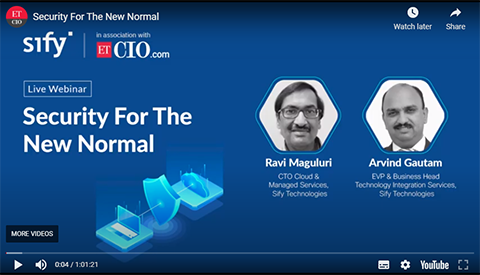
Security For The New Normal
SPEAKERS:
Ravi Maguluri, CTO Cloud & Managed Services, Sify Technologies
Arvind Gautam, EVP & Business Head Technology Integration Services, Sify Technologies
DATE:
November 20, 2020 | 6.00 PM
DESCRIPTION:
Globally, the pandemic has created challenges for businesses and enterprises are struggling to efficiently operate in an altered world. As a result, there is a sudden increase in digital technology adoption, and enterprises are forced to shift their workloads to the cloud. Enterprises are apprehensive about the overall security associated with the cloud.
Understanding the gravity of a secure workplace to drive a secure future, ETCIO in association with Sify is hosting a webinar titled “Security For The New Normal”. Gain the best practices from the industry experts on security and privacy challenges relevant to cloud computing.
Key Takeaways
- Understanding the new threat landscape and designing a detailed strategic roadmap
- Data-centric view of business while migrating to the cloud
- Building a robust Cloud Security Posture for an effective security framework
- Analyzing comprehensive and proven Cloud Access Security
- Identifying security and risk management roles and responsibilities
- Cloud Workload Protection: Better control over assets and build enhanced cloud security and resiliency


Privileged access management through ‘least privilege’ principle
Privileged access management solution to reduce organization’s attack surface, and prevent, respond to, and mitigate damages
Project Objective
Sify helps organizations with its Privileged Access Management solution that helps to reduce their attack surface and prevent and mitigate the damage arising from external attacks as well as from insider threats or negligence. The central goal is the enforcement of least privilege, defined as the restriction of access rights and permissions for users, accounts, applications, systems, devices and computing processes to the absolute minimum necessary to perform routine, authorized activities.
Project Model
Platform as a Service (PaaS) Model
Sify’s Uniqueness
To keep up with ever-evolving cyber threats, Sify’s Technology Innovation Center works continuously to improve security processes and solutions.
Integrated Value and Outcome
- Central SOC operated from Chennai
- Pay only for privileged user count and get unlimited device integration
- Secure access to administrative users to manage the respective endpoints
- Session recording to track administrative changes
- Automated password refresh cycles to manage compliance
- Custom administrative access workflow for access authorization
Value for Client
Sify provides a highly effective Privileged Access Management solution that helps in managing, controlling and monitoring privileged user activities whilst implementing the principle of ‘least-privilege’

Next-generation, AI/ML-based security analytics
Comprehensive SOC, SIEM solution delivers compliance benefits for pharma major along with reduced MTTR, MTTD and single-pane visibility for hybrid and multi-cloud infrastructure
Project Objective
To build a Security Information And Event Management (SIEM) solution, which supports threat detection, compliance and security incident management through the collection and analysis (both near-real-time and historical) of security events, as well as a wide variety of other event and contextual data sources
Project Model
Platform as a Service (PaaS) Model
Sify’s Uniqueness
To keep up with ever-evolving cyber threats, Sify’s Technology Innovation Center works continuously to improve security processes and solutions.
Integrated Value and Outcome
- Central SOC operated from Chennai with platform hosted at Airoli and Bengaluru for DC and DR respectively
- Simplified licensing that is device-based, hence offers predictable billing. No need to worry about EPS spikes anymore.
- Meets next-generation SOC requirements with the addition of UEBA and SOAR
- MITRE ATT&CK framework-based threat mapping
- Wide range of compliance auditing and management reports, including PCI-DSS, HIPAA, and SOX
Value for Client
Sify provides complete next-generation SIEM components for the client to meet their security monitoring and compliance requirements. Clients benefit from single-pane-of-glass visibility for their hybrid and multi-cloud infrastructure security monitoring with improved MTTD and MTTR.

Human errors is now the top threat for information security in organizations
A chain is only as strong as its weakest link. In an enterprise environment, it is often human errors that create the biggest risks. This fact is corroborated by many studies, and more than those, by many outages and episodes. Whether it is ignorance or wilful data theft, the risk that enterprises face from employees and disgruntled ex-employees is as big as (if not bigger than) external cyber threats or APTs. While ignorance has only one reprieve- training and policy enforcement, deliberate thefts can be more difficult to handle, and will need tools as well as stronger security infrastructure tools in place.
In January 2015, P&G USA filed a suit against 4 Gillette employees, for stealing and sharing corporate information with direct competitors. This is a classic case of people risks with sensitive corporate information. In another recent report on a study by Ponemon Institute, employee negligence was identified as the top threat for information security in healthcare organisations. How do CISOs identify a high risk behaviour employee? Also, how do IT organisations fight ignorance and negligence in employees to secure data, to the maximum possible lengths?
Here are some ideas on how to do it…
1. Identify careless employees, increase risk awareness- Tighten up Policies
Simple carelessness on the part of an employee-like forgetting to close a portal when not using it, using weak passwords, allowing unauthorised access to information and the most common- forgetting a mobile in a cab- can cost a company millions in terms of revenue. It can also turn back years of hard work for a market reputation or creation of strategy.
The only solution is constant training and creation of awareness about the risk careless behaviour can carry. Making compliance stronger and more strictly enforceable could help here. Creating clear policies of what is mandatory, at any cost, also helps. Once clear cut guidelines are in place, screening is easier and even re-screening isn’t such a cumbersome task any more.
All access levels need to be defined, especially for business critical systems and data. Strong encryption tools need to be in place, and authentication needs to be a non-compromiseable exercise. Unwanted devices, sites and applications usage needs to be regulated as well. Constant training needs to be in place for cyber security awareness, so employee understand the impact of even a single wrong click that opens a malware laden site. Opening unauthenticated sites, sharing passwords, carrying sensitive information in an unencrypted form- everything needs to be regulated, and the employees made aware of the risk- over and over again!
2. Mobility Led Risks- The rights tools in place
While enterprise mobility cannot be avoided in almost all enterprises, it is one of the highest reasons of data theft and loss. Studies indicate that almost 68% of all global organisations have faced a security threat from employee owned mobile devices.
Every enterprise needs to have tools in place to prevent this risk from blowing into a full outage. Again, a clearly defined BYOD policy is a critical part of this plan. Monitoring personal owned devices, encrypting data before access, are some processes that should be strictly enforced. Security solutions for isolating corporate data and encrypting it are available, and should be used.
3. Disgruntled employees- screening and rescreening would help
While employee background screening is almost mandatory for every organisation, sometime it is just not enough. In many cases, crucial facts about an employee can be missed. In addition, a dissatisfied or frustrated employee is also a threat- and specially one who knows it will be easy to walk away without anyone identifying him or her as the cause of a breach. They will have the satisfaction of causing harm to the company!
For this kind of attitude, a single screening while hiring may not be enough- follow up screenings and re-screening is required. Companies that do not insist on rescreening at regular intervals, expose themselves to threats of all kinds. Having a regular follow up on every employee’s background is an exercise that could probably detect a malignant element in the people strength of the company, which could be the fore-alarm, needed to step up security or deal with it right away.
4. Train and Update- Constantly
There are innovations in tools as well as applications for IT security, as with other technologies, on a rapidly growing basis. Every single threat is another step up for data on risk, and every time this should be documented and shared.
Every enterprise should keep abreast of these innovations, and ensure all employees are trained on a constant basis. By maintaining an updated list of risky behaviour, and the circumstances that lead to a breach, a training manual can be created. Employees need to be regularly trained for what to be cautious about and how to handle a threat. Clearly articulating the ground rules and elaborating on the consequences of the situation will certainly create a culture of security awareness in any enterprise.
Summary
While constantly evolving security technologies are creating updated tools to fight IT security, the single wrong action of an employee can undo the best of guards and checks. Every enterprise needs updated information on these tools, and needs to ensure every employee knows how to NOT be a risk. The education, training and awareness about risky behaviour are essential.
Also essential is the policy to make this awareness mandatory, these rules completely enforceable and the training a part of the corporate culture. While technology and tools can provide the ammunition to prevent breaches, the human element needs enterprise focus as well!

Enterprise Policy Vs Technology – are your people the biggest security risk?
According to a study by Intel in September 2015, almost 43 % of all data breaches were due to insider breaches (half being intentional). Threats perpetuated by disgruntled employees form an overwhelming number in these, especially in the Asia pacific region, where it is the second largest cause of all security breaches.
But despite such staggering figures, very few organisations or IT employees take the insider threat seriously- as low as 20% in the US market. A recent report by Ponemon says that in 2015, while insider attacks weren’t the biggest cause of security breaches, they caused the most damage- about USD 144,000 per instance!
Why?
Globally, very few organisations seem to have a clearly written policy that ensures employee education or affirmation about maintaining security of organisation data. If nothing else, it would help in increasing awareness of what might be dangerous, and lay down the processes for the right way of handling sensitive data!
One of the things this policy needs to define is regulate the privileges that trusted operators have- because they most often have the opportunity to cause most damage. Since they have the privilege to perform any process on critical systems using critical data, they could also, inadvertently or deliberately, be the biggest threat!
Most organisations confuse trust with granting unauthorised access to data for any employee and that has cost many companies dear! A balance between empowering an employee, and access control needs to be in place. In a vast majority of cases the unauthorised access comes from inadvertent sharing or passwords or access to critical data. What’s needed is a strict control on access. But that’s where the challenge lies- overlapping roles and inconsistent entitlements. But even more than that, is the poor governance process that keeps the backdoors open for security policy enforcement. The reason is, very often, that most organisations themselves are unaware of where their critical information is stored. It then becomes difficult to prevent inappropriate transmittal or access in the first place! And in most cases, a company’s reaction to a breach is reactive. There is hardly any attempt for predictive responses. There is almost never any system or policy in place to identify at risk accesses or individuals, so an attack may be pre-emptive or predicted.
Any policy that is to regulate data access to insider threats needs to follow some definitive guidelines. Some permissions and capabilities of employees need to be clearly regulated. These could be:
Data Classification
In order to be able to protect critical data, it first needs to be classified as critical. Understanding the consequences of a leak, an organisation needs to classify information at various levels of criticality and then work on ensuring the various security policies that confirm to each level of protection it needs. The data could include customer data, financial or market data or systems information. Each of these will have a cost attached, and access policies need to be in place for all. In addition, the security algorithms need to be clear on who can access to what levels- read, delete, copy or use in any other manner.
Privileged Identity and Passwords Management policy- a Must
In most organisations, the security and IT admin teams have access to almost all data, but with passwords. In some orgs, leadership and stakeholders are also given access. Such privileges need to be monitored by technology tools as well as policy enforcements. Who gets to see and do what, or Privileged Identity Management, has to be clear and simple but non-compromisable. It should enable regulation of multiple accesses to critical data.
Often many leadership level stakeholders share passwords and authorisations that could compromise key data or systems of a company. A policy that lays down the terms of clear privileged Identity Management can control the risks associated with this multiple usage of passwords and thus, the risk.
RBAC
In most organisations, privileges accesses are all or nothing accesses, often allowing more privileges than a person needs. A regulatory policy should be able to change that, and reduce the unnecessary risk to key data and systems information. Policies governing user entitlements need to be a strict enforcement in every organisation.
Fraudulent Access Identification
In cases where an outsider exploits an insider to access data, the advanced authentication methods should be put in use. These would go beyond passwords, and into the contextual factors. Fraudulent access can be identified by simple ways- time zones- a person logging in from another place within minutes of logging from one- or some security questions answered wrongly- anything could trigger alarm bells and even identify a fraud authentication try. But these also need to be a part of the policy process.
Virtualisation Risks – Need of Security
With innovative technologies like virtualisation, the risks of insider leaks have increased- another layer of administrators for the hypervisor. With the ability of the tool to replicate or transmit data at a single click- the risks have gone up manifold. The solution usually is to embed traditional security apps in the hypervisor layer as well, but the entire virtual infrastructure too, needs to be secured. The security policy needs to have an option for emerging technologies and the risk they pose.
Summary
So, to control the problem of unauthorised access, there needs to be a strict security paradigm with automated processes that meet compliance audits and identity security policies. What’s critical here is the tighter incidence management timelines- that deliver a timely and stronger role based security foundation.