


Integration of cloud, DC and DR
Resilient and integrated IT infrastructure on private cloud, with hosted IT and automated DR helps insurance leader roll out new solutions rapidly, with 10% reduced TCO
Project Objective
Consolidate four data center application workloads and build Managed Private Cloud and DR Services at Sify DC
Project Model
Fully services model (vis-à-vis existing capex + services model)
Sify’s Uniqueness
Integrated value proposition: Cloud Assessment Services, designed a private cloud architecture using Sify CloudInfinit CMP best practices, automated DR on Sify DRaaS model, Telecom Services for DC-DR connectivity, and end-to-end Managed IT Services
Integrated Value and Outcome
Cloud@core products and services:
- Design, build and deploy Hosted Private Cloud Infrastructure.
- Study and migrate close to 20 applications to hosted private cloud with near-zero downtime window.
- Set up DR at a different seismic zone using DRaaS to provide granular data recovery time objectives.
- Implement security framework to comply with the insurance Industry Regulatory Requirements.
- Managed Services using Sify Managed Services Platform covering DC, DR, Branch Network and Security
Value for client
Resilient IT Infrastructure to roll out new solutions at a rapid rate without delays in procurement of new hardware, software and other IT Infrastructure resources with 10% reduction on TCO YoY.


SAP Migrations to AWS Cloud using Cloud Endure Migration Tool
Enterprises migrating SAP workloads to AWS are looking for an as-is migration solution that is readily available. Earlier, enterprises used the traditional method of SAP backup and restore for migration or AWS-native tools such as AWS Server Migration Service to perform this type of migration. CloudEndure Migration is a new AWS-native migration tool for SAP customers looking for assistance with cloud migration services. It is a SaaS service offering from AWS to migrate workloads from any source (physical, virtual, or private/public cloud) to AWS, from one AWS region to another AWS account, and across different AWS accounts. Know more about how CloudEndure enhances our cloud migration services.
Enterprises looking to host a large number of SAP systems onto AWS can use CloudEndure Migration without worrying about compatibility, performance disruption or long cutover windows. You can perform any re-architecture after your systems start running on AWS.
Explore why Sify is ranked among the leading cloud managed services providers globally and our proven expertise in cloud migration services. Click here.
SAP to AWS Cloud Migration Services – Solution Overview
CloudEndure Migration simplifies, expedites and reduces the cost of such migrations by offering a highly automated as-is migration solution. This blog demonstrates how easy it is to set up CloudEndure Migration and the steps involved in migrating SAP systems from source to AWS environment.
Learn more about our cloud migration services and cloud managed services. Click here.
CloudEndure Migration Architecture
The following diagram shows the CloudEndure Migration architecture for migrating SAP systems.
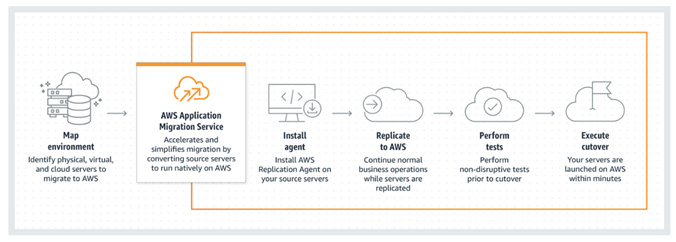
Major steps for this migration are as below:
- Agent Installation
- Continuous Replication
- Testing and Cutover
CloudEndure helps you overcome the following migration challenges effectively:
- Diverse infrastructure and OS type
- Legacy application
- Complex database
- Busy continuously changing workloads
- Machine compatibility issues
- Expensive cloud skills required
- Downtime and performance disruptions
- Tight project timelines and limited budget
Read more about our expertise in cloud migration services. Click here.
SAP to AWS Cloud Migration Services – Use Cases
The most common uses cases for CloudEndure Migration are:
- Lift and Shift, then optimize
- Vast majority of Windows/Linux servers when agent can be installed on source machine
- Replicating Block Storage devices like SAN, iSCSI, Physical, EBS, VMDK, VHD
- Replicating full machine/volume
Benefits of AWS Application Migration Services integration
Access to advanced technology
Simplify operations and get better insights with AWS Application Migration Services integration with AWS Identity and Access Management (IAM), Amazon CloudWatch, AWS CloudTrail, and other AWS Services.
Minimal downtime during migration
With AWS Application Migration Service, you can maintain normal business operations throughout the replication process. It continuously replicates source servers, which means little to no performance impact. Continuous replication also makes it easy to conduct non-disruptive tests and shortens cutover windows.
Reduced costs
AWS Application Migration Service reduces overall migration costs as there is no need to invest in multiple migration solutions, specialized cloud development, or application-specific skills. This is because it can be used to lift and shift any application from any source infrastructure that runs supported operating systems (OS).
Conclusion
This blog discussed how Sify can help its SAP customers migrate to AWS Cloud using CloudEndure tool. Sify would be glad to help your organization as your AWS Managed Services Partner for a tailor-made solution involving seamless cloud migration services experience and for your Cloud Infrastructure management thereafter.
CloudEndure Migration software doesn’t charge anything as a license fee to perform automated migration to AWS. Each free CloudEndure Migration license allows for 90 days of use following agent installation. During this period, you can start the replication of your source machines, launch target machines, conduct unlimited tests, and perform a scheduled cutover to complete your migration.

Automated Recovery of SAP HANA Database using AWS native options
This blog exclusively covers the options available in AWS to recover SAP HANA Database with low cost and without using native HSR tool of SAP. With a focus on low costs, Sify recommends choosing a cloud native solution leveraging EC2 Auto Scaling and AWS EBS snapshots that are not feasible in an on-premises setup.
Solution Overview
The Restore process leveraging Auto Scaling and EBS snapshots works across availability zones in a region. Snapshots provide a fast backup process, independent of the database size. They are stored in Amazon S3 and replicated across Availability Zones automatically, meaning we can create a new volume out of a snapshot in another Availability Zone. In addition, Amazon EBS snapshots are incremental by default and only the delta changes are stored since the last snapshot. To create a resilient highly available architecture, automation is key. All steps to recover the database must be automated in case something fails or goes wrong.
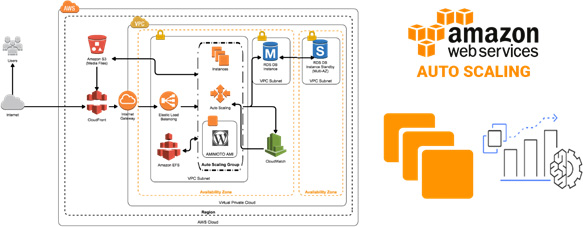
Autoscaling Architecture
The following diagram shows the Auto Scaling architecture for systems in AWS.
Use Case
EBS Snapshots
Prior to enabling EBS snapshots we must ensure the destination of log backups are written to an EFS folder which is available across Availability Zones.
Create a script prior to the command to be executed for an EBS snapshot. By using the system username and password, we make an entry into the HANA backup catalog to ensure that the database is aware of the snapshot backup. We use the snapshot feature to take a point in time and crash consistent snapshot across multiple EBS volumes without a manual I/O freeze. It is recommended to take the snapshot every 8-12 hours.
Now the log backups are stored in EFS and full backups as EBS snapshots in S3 and both sets are available across AZs. Both storage locations can be accessed across AZs in a region and are independent of an AZ.
EC2 Auto Scaling
Next, we create an Auto Scaling group with a minimum and maximum of one instance. In case of an issue with the instance, the Auto Scaling group will create an alternative instance out of the same AMI as the original instance.
We first create a golden AMI for the Auto Scaling group and the AMI is used in a launch configuration with the desired instance type. With a shell script in the user data, upon launch of the instance, new volumes are created out of the latest EBS snapshot and attached to the instance. We can use the EBS fast snapshot restore feature to reduce the initialization time of the newly created volumes.
If the database is started now (recently), it would have a crash consistent state. In order to restore it to the latest state, we can leverage the log backup stored in EFS which is automatically mounted by the AMI. Additional Care to be taken so that the SAP application server is aware of the new IP of the restored SAP HANA database server.
Benefits
- Better fault tolerance – Amazon EC2 Auto Scaling can detect when an instance is unhealthy, terminate it, and launch an instance to replace it. Amazon EC2 Auto Scaling can also be configured to use multiple Availability Zones. If one Availability Zone becomes unavailable, Amazon EC2 Auto Scaling can launch instances in another one to compensate.
- Better availability – Amazon EC2 Auto Scaling helps in ensuring the application always has the right capacity to handle the current traffic demand.
- Better cost management – Amazon EC2 Auto Scaling can dynamically increase and decrease capacity, as needed. Since AWS has pay for the EC2 instances, billing model can be used to save money, by launching instances only when they are needed and terminating them when they aren’t.
Conclusion
This blog discussed how Sify can help SAP customers to save cost by automating recovery process for HANA database, using native AWS tools. Sify would be glad to help your organization as your AWS Managed Services Partner for a tailor-made SAP on AWS Cloud solution involving seamless cloud migration experience and for your Cloud Infrastructure management thereafter.

Fast-track your SAP’s Cloud Adoption on AWS, with Sify
Cloud computing (which later became known as just Cloud), one of the technology trends since last few years, has become a game-changer. Cloud offered a platform for organizations not just to host their applications but also to maintain it / manage it and charge organizations on a pay-per-usage model. This translated into getting rid of the Capex (Capital expenditure on hardware/servers) and instead, opting for the flexible Opex (Operating Expenses) model which also helped organizations in slashing the manpower budget.
The biggest advantage of Cloud is its scalability – freedom to add/reduce storage/compute/network bandwidth as per the need within an agreed SLA-framework.
The rise of Cloud adoption led to two categories:
- Cloud as a hosting platform
- Cloud-based software/applications
Cloud as a hosting platform
This is more popularly known as Platform-as-a-Service (PaaS) or Infrastructure-as-a-Service (IaaS) wherein the service provider offers bundled services of Compute, Storage, Network & Security requirements.
Cloud providers deliver a computing platform, typically including operating system, programming language execution environment, database, and web server. Application developers can develop and run their software solutions on a cloud platform without the cost and complexity of buying and managing the underlying hardware and software layers.
Based on the deployment options, Cloud is classified under Public, Private and Hybrid Cloud, which vary due to security considerations.
Why AWS
With some PaaS providers like AWS, the underlying compute and storage resources scale automatically to match application demand so that the cloud user does not have to allocate resources manually. They use a load balancer which distributes network or application traffic across a cluster of servers. Load balancing improves responsiveness and increases availability of applications.
As per a 2020 IDC study, over 85% of customers report cost reduction by running SAP on AWS.
Get consulting support, training, and services credits to migrate eligible SAP workloads with the AWS Migration Acceleration Program (MAP).
AWS has been running SAP workloads since 2008, meaningfully longer than any other cloud provider. AWS offers the broadest selection of SAP-certified, cloud-native instance types to give SAP customers the flexibility to support their unique and changing needs.
Whether you choose to lift and shift existing investments to reduce costs, modernize business processes with native AWS services, or transform on S/4HANA, reimagining is possible with SAP on AWS.
When you choose AWS, you will be joining 5,000+ customers who trust the experience, technology, and partner community of AWS to migrate, modernize, and transform their SAP landscapes.
AWS & Sify collaboration
While AWS has been a global leader in Public Cloud services, in India Sify Technologies (one of the pioneers in the ICT domain & India’s first SSAE-16 Cloud certified provider) had designed its own Cloud called ‘CloudInfinit’ way back in 2013 and since then has been helping diverse organizations in moving their ERP applications, especially SAP workloads to its Cloud, seamlessly.
With Sify’s cloud@core strategy, customers can enjoy all facets of Cloud with complete visibility and control.
SIFY’s SAP deployment flexibility ON CLOUD
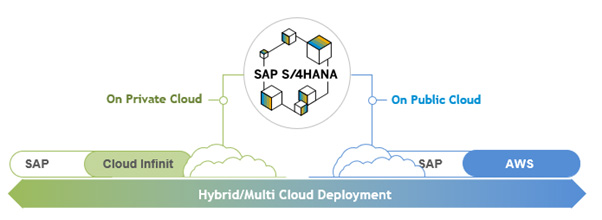
SAP on AWS hybrid cloud solutions
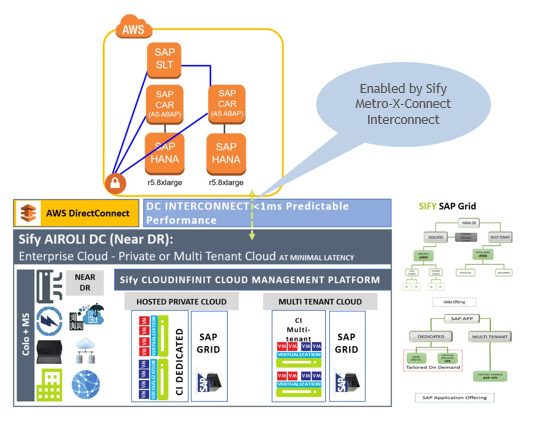
Use Cases
- Lifecycle Distribution: Separate Development and Test Environments
- Workload Distribution
- High Availability Deployments
Business Benefits
- Best of breed performance with Hybrid Cloud configuration
- Efficient integrations with extended ecosystems
- Compliance with data sovereignty
- Business continuity with resilience
- Simplicity with self service
- Operational efficiency with reduced IT administration
- Cost reduction with on-demand bursting to public clouds
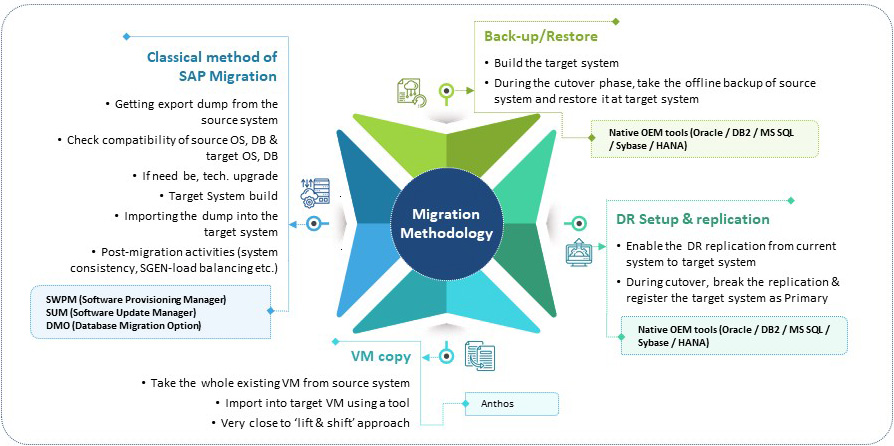
Migration methodology
For SAP Migrations from on-premises or from any other Cloud to AWS, depending on various parameters like Prod. database size, available downtime window, source/target operating system/database, connectivity/link speed etc., we have been using various ways for seamless migration briefly explained below.
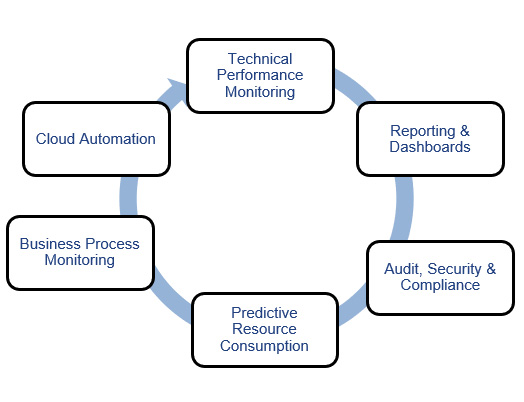
SAP SYSTEMS monitoring
Once SAP workloads are moved to AWS, Sify’s Managed Services takes care of every aspect, including monitoring the Operating System, Database, Connectivity, Security, Backup etc. as per the agreed SLAs. It also monitors the mission-critical SAP systems closely as depicted in diagram below.
Conclusion
Cloud, the scalable, flexible and yet robust hosting platform allows you to use your ERP workloads as well as SaaS applications effectively. Going by the increasing number of customers moving to Cloud, it is certain that Cloud is not vaporware, it is here to stay and only to grow bigger and safer by the day! It would also necessitate organizations to chart out a Smart Cloud strategy.
Embrace the Hybrid Cloud with VMC on AWS
According to Gartner, most of the midsize and enterprise customers will be adopting multi or hybrid cloud services. Companies have already realized that in order to move to the public cloud, it is important to structure workload in a hybrid cloud model.
Companies must understand that hybrid IT is not an easy methodology and therefore they must organize their existing IT resources and application workloads both on-premises and in public cloud efficiently to accomplish the goals of hybrid model. Additionally, they must also look for the right skills for different private/public clouds and different sets of tools from respective cloud and hybrid cloud managed services providers.
At Sify, we define some guidelines and structures to right-fit your workloads in the hybrid cloud. Please read on to know how Sify can help customers identify the right cloud (from the set of appropriate private and/or hosted private cloud services) for different sets of workloads.
Learn why we are one of the most trusted providers of hybrid cloud managed services globally. Read about our hybrid cloud managed services offering to know more.
Unique Challenges in Hybrid Cloud and Hybrid Cloud Services
In hybrid cloud, there are some unique challenges that businesses need to address first. Key challenges that need to be addressed while designing solutions on Hybrid Cloud are mentioned herein.
- Generally, it is very difficult to identify the most suitable cloud environment and manage the cost of different clouds.
- Though all cloud environments are powerful in providing features like scalability and elasticity, however the process of managing a hybrid cloud is quite a complex task.
- Security Risks: The threat of data breach or data loss is perhaps the biggest challenge faced during hybrid cloud adoption. Generally, companies prefer on-premises private clouds to protect data locally. However, in order to ensure top-tier security of data and applications on hybrid cloud, companies must draft robust data protection policies and procedures.
How can you migrate your workloads seamlessly to hybrid cloud? Read about our cloud migration services and hybrid cloud managed services offering to know how we can help.
Identify Applications for Hybrid Cloud
It is very important to identify applications for hybrid cloud, and your decision must be based on application’s architecture, behavior and user accessibility. Below are some key points to remember while designing an effective hybrid cloud strategy: –
- Consider the compatibility of applications before deciding whether you want to continue running the applications in an on-prem cloud environment or migrate them to Public Cloud.
- Identify the running cost/budget for an application and compare it with different cloud providers to choose the most suitable cloud platform that suits your budgetary outlines and business requirements.
- Pay due attention to licensing requirements before migrating to Public/Private Cloud because a minor loophole in this aspect can have a major impact on the overall business.
- Relook experience of existing IT teams to manage different Private/Public clouds seamlessly.
Not sure how to take the first step? Connect with us to explore our proven capabilities in hybrid cloud services, cloud migration services and hybrid cloud managed services. Click here.
Why VMC on AWS as Hybrid Cloud Choice?
VMware Cloud (also called as VMC) on AWS brings VMware’s enterprise-class Software-Defined Data Centre software to the AWS Cloud and enables customers to run production applications across VMware vSphere-based private, public, and hybrid cloud environments, with optimized access to AWS services.
AWS is VMware’s preferred public cloud partner for all vSphere-based workloads. The VMware and AWS partnership delivers a faster, easier, and cost-effective path to the hybrid cloud while allowing customers to modernize applications enabling faster time-to-market and increased innovation.
New Amazon EC2 i3en.metal instances for VMware Cloud on AWS, powered by Intel Xeon Scalable processors, deliver high networking throughput and lower latency so you can migrate data centers to the cloud for rapid data centers evacuation, disaster recovery, and application modernization.
VMC on AWS can be the right choice because VMware has been a trusted virtualization platform for many years in the industry and enterprise VMware ensures that all your applications run seamlessly. Plenty of companies are already running on VMware platform and have applications running on it. Below are some key identifiers for VMC on AWS:
- VMware SDDC is running on bare metal, which is delivered, operated, supported by VMware
- On-demand scalability and flexible consumption
- Full operational consistency with on-premises SDDC
- Seamless workload portability and hybrid operations
- Global AWS footprint, reach, and availability
- Native AWS services accessibility
Explore Sify’s expertise in the hybrid cloud and hybrid cloud managed services space. Click here.
How VMC on AWS Solution Works
VMware Cloud on AWS infrastructure runs on dedicated, single tenant hosts provided by AWS in a single account. Each host is equivalent to an Amazon EC2 I3.metal instance (2 sockets with 18 cores per socket, 512 GiB RAM, and 15.2 TB Raw SSD storage). Each host is capable of running many VMware Virtual Machines (tens to hundreds depending on their compute, memory and storage requirements). Clusters can range from a minimum 3 hosts up to a maximum of 16 hosts per cluster. A single VMware vCenter server is deployed per SDDC environment.
How do We Access AWS Services?
For companies that are using VMware Cloud on AWS (VMC) as a production environment for their business-critical application, it will require connectivity to an AWS account. This is enabled by an AWS elastic network interface which provides a 25Gbps connectivity between VMC and AWS. Applications deployed on VMC can leverage native AWS services for storage, EC2 instances, RDS Databases, load balancing and DNS routing, etc., providing customers with the best of both worlds. These native services can be accessed from applications deployed on VMC and include:
- Simple Storage Service (S3)
- Elastic File Service (EFS)
- Amazon Relational Database Service (RDS)
Sify’s Value Propositions to Help Customer Who are Looking for Hybrid Cloud Services
Sify has been in the Cloud industry since 2012 and has its own cloud for enterprise customers which can be tailored based on the requirement. Over the last few years, Sify has been involved in large enterprise customer requirement understanding, solutions & implementation across Private, Public & Hybrid Clouds.
Sify has dedicated, experienced and certified SMEs involved during solution stage and implementation and to provide operations services which will enable businesses to accelerate the adoption of Hybrid Cloud.
Our approach is to identify potential use cases for Hybrid Cloud options for VMC on AWS and native AWS services during the initial assessment and design phase, and we also suggest the most suitable services that can help customers meet the strategic goals. These services include the following:
- Discovery Workshop
- Assessment
- Build and Migrate
Feel free to contact us to provide your organization with tailored solutions with the required support across the various stages of the setup of VMC & AWS and migration of workloads.

India’s First Commercial Data Center completes 21 years in Operation
Sify’s facility at Vashi was the first of the 10 Company-owned Data Centers
Chennai, Sep 20, 2021— Sify Technologies Limited (NASDAQ: SIFY), India’s most comprehensive ICT solutions provider today announced that its Data Center at Vashi, the first commercial Data Center in India, completed 21 years of uninterrupted operations.
Sify Technologies expanded into the Data Center business in the year 2000. Sify has built and today operates 10 carrier-neutral Data Centers, currently offering more than 70 MW IT Power. Following the facility at Vashi, Sify followed up with larger capacities in Bangalore, Chennai, Airoli, Noida, Rabale, Hyderabad and Kolkata and aims to add 200 MW in the next 4 years. Through CloudCover, Sify also services a network of 49 Data Centers across India.
Delighted at this milestone achievement, Mr. Raju Vegesna, Chairman, Sify Technologies, said “Sify has pioneered and set high standards in the Data Centre space in India ever since the launch of country’s first concurrently-maintainable data center at the Infotech Park in Vashi, Mumbai in September 2000. Sify was the first to foresee the scope for Data Center as a business vertical in India and hence aggressively invested in the key markets. Today, the combined strength of our Data Centers and Network connectivity puts us in an unbeatable position to drive digital transformation across the nation.”
Mr. Kamal Nath, CEO, Sify Technologies, said “This 21st anniversary of our Vashi Data Center is testimony to Sify’s legacy in the Data Center business in India. Our data center footprint across the country powers our cloud@core philosophy and drives the Integrated Data Center solutions that we offer to our clients to help them meet their digital transformation goals.”
Key advantages/ features of Sify Data Centers
- Strong connectivity with cloud cover and cost saving with cross connects
- Leading industry SLAs supporting colocation agreements
- Carrier neutral services
- Earthquake resistant structure
- Proven capability to meet 99.982% uptime
- Connectivity from major telecom carriers
- On demand cloud and Managed hosting services
About Sify Technologies
A Fortune India 500 company, Sify Technologies is India’s most comprehensive ICT service & solution provider. With Cloud at the core of our solutions portfolio, Sify is focused on the changing ICT requirements of the emerging Digital economy and the resultant demands from large, mid and small-sized businesses.
Sify’s infrastructure comprising state-of-the-art Data Centers, the largest MPLS network, partnership with global technology majors and deep expertise in business transformation solutions modelled on the cloud, make it the first choice of start-ups, SMEs and even large Enterprises on the verge of a revamp.
More than 10000 businesses across multiple verticals have taken advantage of our unassailable trinity of Data Centers, Networks and Security services and conduct their business seamlessly from more than 1600 cities in India. Internationally, Sify has presence across North America, the United Kingdom and Singapore.
Sify, www.sify.com, Sify Technologies and www.sifytechnologies.com are registered trademarks of Sify Technologies Limited.
Forward Looking Statements
This press release contains forward-looking statements within the meaning of Section 27A of the Securities Act of 1933, as amended, and Section 21E of the Securities Exchange Act of 1934, as amended. The forward-looking statements contained herein are subject to risks and uncertainties that could cause actual results to differ materially from those reflected in the forward-looking statements. Sify undertakes no duty to update any forward-looking statements.
For a discussion of the risks associated with Sify’s business, please see the discussion under the caption “Risk Factors” in the company’s Annual Report on Form 20-F for the year ended March 31, 2021, which has been filed with the United States Securities and Exchange Commission and is available by accessing the database maintained by the SEC at www.sec.gov, and Sify’s other reports filed with the SEC.
For information, please contact:
Sify Technologies Limited
Mr. Praveen Krishna
Investor Relations & Public Relations
+91 44 22540777 (ext.2055)

Embarking on a successful Microsoft Cloud journey with Sify
In the digital age, migration to Cloud has become the top-most priority for businesses across realms. We are seeing major shift in the number of ‘Cloud Hostile’ customers turning into ‘Cloud Friendly’ & ‘Cloud Ready’ customers and pondering on the best plan to implement the migration successfully.
Know more about Sify’s offerings in the cloud migration services space.
One of the major reasons behind this trend – besides performance, security, and cost – is agility & flexibility which help in faster business innovations. Organizations have started transforming themselves digitally to drive business value and grow business with enhanced end user experience.
Over the past few years, Microsoft has earned massive popularity among organizations worldwide for being a leading Cloud and cloud managed services provider with – Azure, Microsoft 365 (M365) and Microsoft Dynamics 365.
Microsoft Azure is a highly productive, hybrid, and intelligent Cloud that allows you to leverage the power of cutting-edge digital technologies to build, deploy and manage critical applications as per your company’s requirements. It also provides Cloud enhanced services like AI/ML, RPA, Analytics tools, and integrated Cloud resources to make your organization more agile and improve top-line performance.
Learn more about Sify’s capabilities in the Microsoft Azure managed cloud services domain.
Considering the above benefits, many forward-looking businesses are exploring Azure Cloud-powered services and Azure managed cloud services to optimize internal processes and generate new business models. However, this digital aspiration is incomplete without transforming the technology landscape first. A strong technology foundation provided by Microsoft will help you connect your disparate data, processes, users, and applications to accomplish the end objective of organizational excellence.
Achieving all these is not as simple as it may seem initially! That’s where, Sify’s consultative approach and Azure managed cloud services capabilities can help you leverage the true value of Microsoft Services and align your organizational roadmap with the ever-evolving technology landscape.
Explore why Sify ranks high among the leading cloud managed services providers across the globe. Know more about our public, private, multi- and hybrid cloud managed services capabilities.
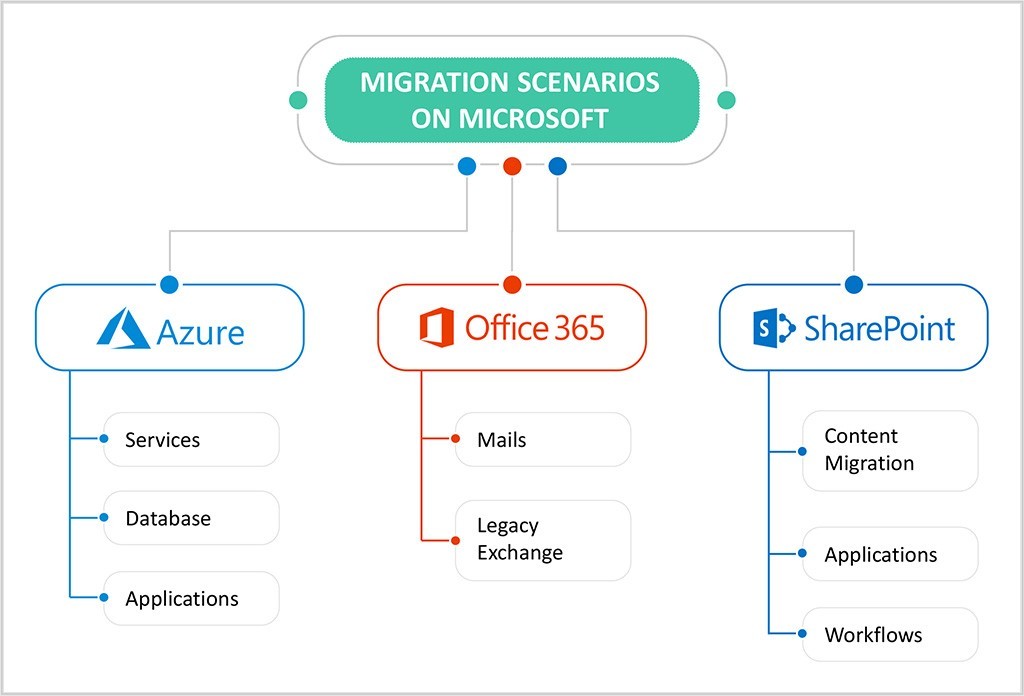
Azure Migration: The most successful path
Different organizations have distinct approach towards Cloud migration and need different types of cloud migration services, and their decisions are governed by business specific priorities and constraints. You must know that Cloud migration services involve significant organizational change management across people, process, and technology. It’s very important to draft a holistic approach to migrate successfully and realize the benefits of efficiency, agility, and cost.
Sify’s cloud migration services for Azure
As a trusted partner among cloud managed services providers globally, Sify offers unmatched capabilities in cloud migration services. With Sify as your strategic partner for cloud migration services, you are perfectly positioned to draft, implement, and monitor the overall migration plan in the most successful way. Our team of Cloud experts, Azure certified professionals, cutting-edge toolchains, and partner ecosystem can help you accomplish migration goals successfully. Our cloud migration services can help you across all three phases of migration – assessment, migration, and optimization.
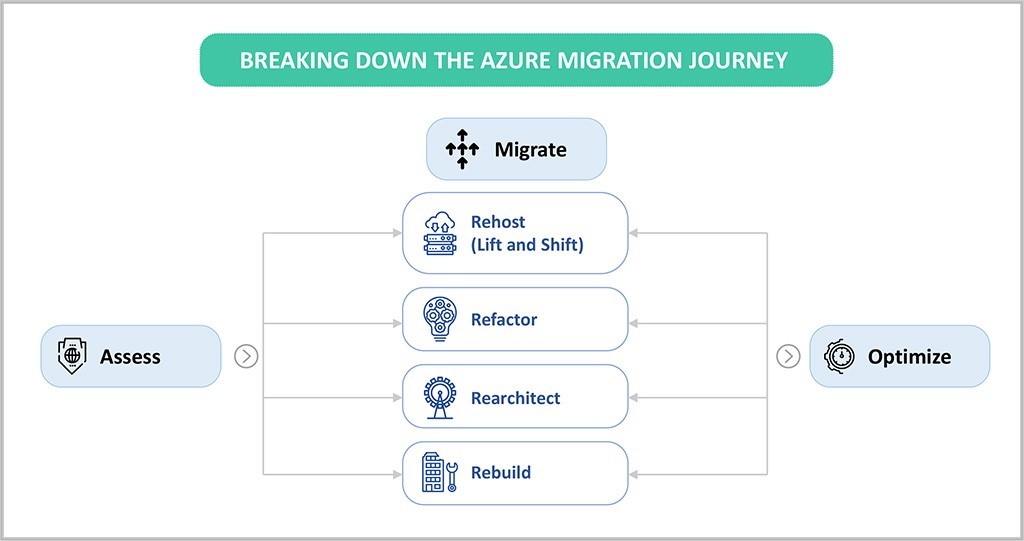
Assessment: This is the first phase of migration journey, which includes assessing and discovering your on-premises apps, data, and infrastructure. Our comprehensive range of cloud migration services and assessment services can help you map dependencies across applications and decide their priority of Azure migration for a seamless journey.
Migration: The actual cloud migration begins in this phase, where you start moving your apps, data and infrastructure – leveraging the best-suited cloud migration services, strategies and tools. Our cloud migration services will help you automate the entire migration journey (depending upon your IT specific needs) and minimize the downtime.
Optimization: Once you have moved to Cloud, it becomes important to monitor your Cloud resources continuously for better performance, enhanced security, and reduced cost. Consistently ranked among the leading cloud managed services providers, our managed services will help you maximize your ROI and leverage unified visibility of Cloud resources for efficient resource utilization and optimization.
Explore how Sify’s cloud migration services bring the assurance of high rates of success. Know more about our public, private and hybrid cloud managed services and migration capabilities.
Sify + Azure Advantage
- Single window solution provider (Network, Security, Azure IT and Management)
- End-to-end Azure service coverage: Access – Architect – Migrate – Manage – Secure
- Integrated Azure network and security proposition
- Unified Dashboard across Azure IT
- Simplified Execution and single point of ownership
Know more about transforming your IT Infrastructure with Sify’s Microsoft Azure managed cloud services capabilities.
Microsoft 365 – Mail migration
With Office 365 becoming the de-facto mode for conducting business, it is important to modernize the underlying infrastructure and platform. It is imperative for enterprises to move their legacy exchange and other mailboxes to Office 365 in order to reap full benefits of their workflow optimizations. Additionally, Office 365 offers the benefit of pay per use pricing for optimizing cost.
So in case, you are exploring the possibilities to conceptualize and implement your cloud migration in the most success-driven manner, Sify can help you embark on a successful Microsoft Cloud journey.
Our Accreditations
- Microsoft Certified Partner for Cloud & Managed Services
- Certified Deployment Partner for deployment of M365 & Azure services
- Express Route Partnership for seamless connectivity with MS Cloud Azure & Microsoft 365
- Certified team for Migration & Deployment of MS SQL workloads
- Certified team for deployment of Hybrid Cloud Platform

Simplified Cloud Adoption for SAP S/4HANA
Let Sify, your Cloud expert manage your SAP Migration

Every transformation journey begins with adoption of digital technologies on Cloud. Forward-looking organizations worldwide are looking for Cloud-powered solutions to attain the highest level of business agility, scalability, and compliance in the most cost-effective way. Additionally, Cloud-powered solutions facilitate access to new generation technologies, such as IoT, AI, and ML, which help you achieve your transformation goals in an outcome-focused manner.

SAP S/4HANA is a modern business solution suite that fosters intelligent innovations, business process improvement, and IT landscape transformation, without any upfront capital investment in infrastructure, database, hardware, etc. Moreover, it comes with pervasive data modelling capabilities and simplified deployment roadmap options.
Cloud adoption for SAP S/4HANA
Powered with Cloud and Analytics, SAP S/4HANA is undoubtedly a comprehensive, intelligent business suite delivering to organizations, unique insights, and intelligence. However, moving to SAP S/4HANA is not as simple as it may seem initially. It is dependent on your insight and capability to fundamentally examine your business processes, infrastructure, and data. Furthermore, you need to reconsider your business objectives and project priorities to achieve seamless migration to Cloud and realize all its benefits.
To evaluate how SAP S/4HANA can benefit your organization, it is always sensible to assess the consumption and configuration of your existing SAP environment. Subsequently, you need to create a migration to Cloud roadmap for seamless technical deployment, depending on project specific requirements, strategic transformation goals, etc.
Irrespective of the approach you choose, be it New Implementation or System Conversion, there are various advisory tools, such as Business Scenario Recommendations, Readiness Check Tool, etc. that can help you gain the necessary insight and confidence to simplify your move to SAP S/4HANA. After gaining clarity, you should continue forward with your S/4HANA adoption on Cloud in a phase-driven manner.
Five phases of successful SAP S/4HANA Cloud journey

Re-evaluate your current stage and develop a vision:
Before you start your Cloud journey, answer the reasons behind it. You need to evaluate your current IT landscape, analyze your business strategy, consider cross-functional dependencies, and develop a strategic vision before moving to SAP S/4HANA. Herein, Business Scenario Recommendations (BSR) for SAP S/4HANA can help you generate a comprehensive report on how your current system would be impacted and how you should prepare adeptly to derive true value propositions.

Explore the value of SAP S/4HANA:
Once you have evaluated your business landscape, you must start exploring all the value propositions of SAP S/4HANA that can help you transform the overall IT landscape and improve business processes. Mapping key business functions is yet another major area you need to consider while analyzing the values of SAP S/4HANA. SAP Innovation & Optimization Pathfinder can help you analyze all the business improvement opportunities. It also provides rich analysis of innovation recommendations, innovation acceleration, and IT optimization.

Future State Design:
During this phase, you need to start focusing on the technical aspects of your migrating specific parts of your IT landscape or processes to SAP S/4HANA. It is always advisable to define processes and IT landscape that you think are suitable for SAP S/4HANA in order to devise a future-ready migration layout. During this phase, organizations count on different tools such as Readiness Check and Maintenance Planner. Readiness Check highlights the required solution adjustments that are needed for system conversion. Maintenance Planner generates the stack file online from SAP marketplace, which is required to download the SAP S/4HANA software.

Migration and roadmap:
Before the transition begins, you need to outline clearly defined migration strategies to identify, evaluate and select the best migration scenario. To attain seamless transformation and successful SAP S/4HANA migration, you must define the strategy that best suits your vision depending on your current IT stage.

Plan S/4HANA Implementation:
The actual transition begins in this phase, and you must embrace a high-level project management approach to successfully migrate to SAP S/4HANA. As majority of organizations lack technical skill, competence, and expertise to implement such a project, it makes good business sense to collaborate with an expert.
Why Sify for SAP migration, infrastructure, and management?
It is important not to get overwhelmed by the adoption complexity, as finding the right partner will alleviate most of your concerns. Sify has a rich experience and all the state-of-the-art tools required for successfully migrating heterogeneous or homogeneous SAP workloads and managing them.
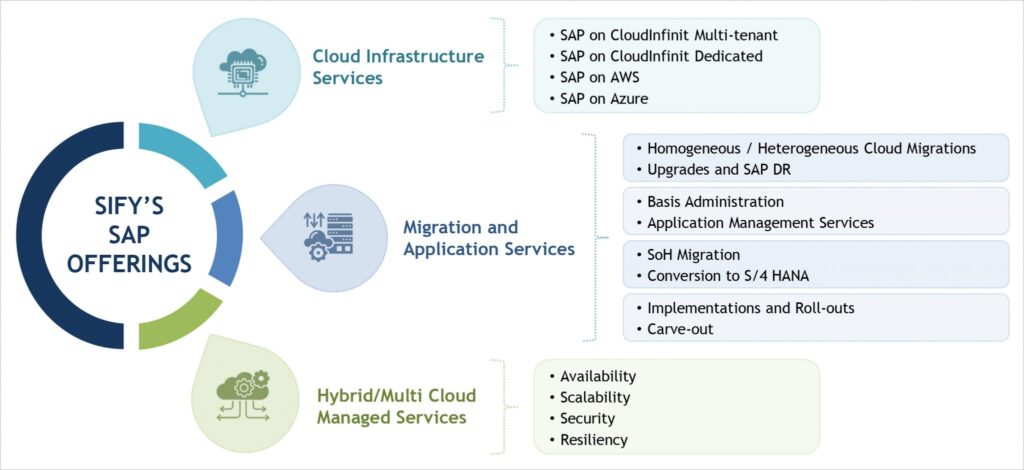
Sify provides you the option of choosing the most appropriate environment for your SAP workloads. You can host your SAP workloads on HANA grid (which is certified by SAP) on Sify’s proprietary Cloud – CloudInfinit. You also have the choice of deploying it on a Hyperscaler (AWS, Azure, etc.) with DR on Sify’s SAP grid or vice versa to leverage the benefits of Hybrid Cloud. Furthermore, we hold a distinct level of specialization in ECC to S/4HANA conversions, implementation and carve out scenarios. Sify’s integrated play across Network, Cloud and SAP ensures that you get flexibility, agility, and choice for comprehensive coverage of all your SAP needs.
Snapshot of Sify’s SAP offerings

Migration to Oracle Cloud: common pitfalls and best practices
Count on Sify to accomplish your migration goals
Enterprises worldwide are in a quest to leverage the true potential of the Cloud. As Cloud allows organizations to unify disparate business functions, streamline processes, enhance organizational efficiency, achieve resilience, and control cost, decision-makers across the business world are looking for the most suitable Cloud and a competent Cloud partner.
Herein, Oracle Cloud has certainly been able to garner attention by helping organizations optimize IT infrastructure, achieve operational excellence, and reduce cost significantly. Oracle ensures a very unique value proposition as it uses the same on-premises products and tools for Cloud. It is built from on-prem deployments, unlike other Cloud providers which started with a Cloud-native approach only. As organizations transition their processes, business functions, or implement a complete transformation to the Cloud, the “integration” between different Cloud and on-premise enterprise applications will be the focus. We know that not all enterprise applications will migrate to the Cloud at the same time, therefore it is imperative that existing on-premise integration is utilized to communicate between the on-premise applications and the Cloud applications via a common cloud integration platform. In such a situation, Oracle certainly ensures distinct advantages.
Oracle is the only cloud provider to offer guaranteed availability, management, and performance SLAs. Moreover, it also ensures greater control and visibility of Cloud resources, which further helps in improving top-line business performance. That’s why organizations are keen to migrate to Oracle Cloud.
However, organizations face distinct challenges and complications while executing the migration plan. As we work with organizations (across verticals) for their Cloud transition or migration projects, we have gained expertise in helping them identify all pitfalls and follow a trusted approach to create and implement successful migration to Oracle Cloud.
This blog highlights the major challenges faced by organizations during their migration journey to Oracle Cloud and the best practices to tackle those challenges. Furthermore, we shall discuss how Oracle Cloud, Sify’s hybrid IT-ready data centers (with Cloud Adjacent and Near Cloud data centers), and Network Services can help you accomplish your Cloud transformation goals competently.
 |
CHALLENGE: Not every workload is Cloud-ready for Lift-N-Shift |
 |
BEST PRACTICE: De-couple the workloads into different categories |
It’s a well-known fact that not all workloads can be migrated to Cloud using the same migration strategies. Therefore, Sify has come up with a comprehensive range of Cloud Assessment Services which help you decouple the workloads into two broad categories – the workload that must be migrated to Oracle Cloud and the workloads that can be hosted in Sify’s Hybrid IT-ready DC. This will help you draft the most appropriate and cost-effective Cloud adoption/migration plan.
|
CHALLENGE: Inter-dependency between applications |
|
BEST PRACTICE: Build migration specific business case for each application |
Sify’s Cloud Assessment and Migration Services help you identify inter-dependency between applications and build migration specific business case considering each application. Our Hybrid IT-ready data centers allow you to establish fast and secure interconnection among all your applications hosted in Oracle Cloud, without any network latency issue.
|
CHALLENGE: How to deal with legacy applications |
|
BEST PRACTICE: Leverage Cloud Integration Platforms for hybrid deployments |
As all enterprise applications cannot be migrated to Cloud due to architectures, dependencies, and cost, there needs to be effective integration between legacy and cloud applications. Sify is uniquely positioned not just with the ability to meet Network SLAs but also with the ability to design, implement and manage hybrid deployments with legacy on-premise applications and the Cloud applications, via a common Cloud integration platform leveraging Oracle technologies.
Count on Sify for a successful migration to Oracle Cloud
Sify complements Oracle’s public Cloud portfolio with its expansive service portfolio encompassing data center services, migration and assessment services, telecom, and managed services. This offers customers a holistic value proposition for their Cloud journey which no other service provider can offer.
With the Oracle Cloud data center co-located with us, Sify is in a unique position to offer customers the advantages of Oracle public Cloud and co-location of partial workloads from the same premises which are interconnected through a high speed, low latency, and highly secure ‘FastConnect’ link. This allows customers to go for their own hybrid data centers without having to worry about latency issues.
With our cloud@core strategy, Hybrid IT-ready Data Centers and Network Services offering <1ms latency for Hybrid deployments, we are the only Cloud Transformation partner that can help you leverage the true potential of hybrid Cloud. Our Hyperscale Cloud and Data Center Services, low latency, high bandwidth, and secure connections to Oracle Cloud ensure better performance at predictable costs. Moreover, our team of competent Cloud experts and Oracle-certified solution architects are willing to offer prescriptive guidance at every stage of your Cloud adoption and transformation, to help you achieve your Oracle migration goals.

Business use cases for high-performance computing
Emerging technologies such as IoT, Artificial Intelligence, and Machine Learning have not only changed the business dynamics but have been generating an exponential volume of data, posing difficulties in its management. Processing this exponential burst of data with varying workloads in a timely and cost-efficient manner requires modern systems like High Performance Computing (HPC). Despite being in its early adoption stage, HPC is quite promising, as it has the capability to solve emerging business problems. Many business use cases have been developed, capturing the attention of the enterprises across the globe. Some of these use-cases where HPC has helped enterprises solve their problems are discussed here.
Fraud detection in the financial industry
Financial frauds have rocked the world with their inventiveness and scale. Some high-profile frauds such as Ponzi schemes, misleading investment schemes, identity fraud, phishing, card fraud, counterfeiting, skimming, fake prizes, and inheritance scams have duped many unsuspecting investors or users. The Global Economic Crime and Fraud Survey conducted by PwC in 2018 reveals that 49% of the organizations faced an economic fraud in the previous two years. While 52% of these threats were internally born, 40% were from external sources.
With a centralized system of fraud detection, information can be gathered from all the available sources. This system can help detect and prevent cyber-attacks, improve data privacy, enhance data protection, and support the digital forensic investigation. Given the humongous volumes of data, the system that is installed must have the capability to detect anomalies and intrusion attempts. Legacy data centers, despite their high capacities, are incapable of handling such large volumes of data. In this scenario, High Performance Computing can prove to be a useful aid in modern fraud detection and risk modeling, thereby helping financial organizations detect attacks on their systems as they occur, preventing financial fraud. PayPal implemented an HPC environment, and within a year of its adoption, it was able to save $710 million that would have been stolen by cyber thieves.
Personalized healthcare and clinical research
Modern advancements in healthcare have helped in the development of many pharmaceutical drugs and in identifying treatment options for a variety of ailments. The adoption of information technology by physicians, surgeons, and other medical professionals has helped them deliver accurate and timely medical treatment to their patients. Advanced medical simulations are often employed to ascertain the positive and negative effects of medicines on a patient profile to determine the most effective treatment option. These simulations demand high computing power as a number of factors need to be taken into account. This is another area where High Performance Computing can come to the aid of medical professionals with its significant computational power. Medical professionals can drill down into patient information at the genomic level, using millions of data points to help diagnose and identify personalized treatments for the patient.
Large hospitals have been using HPC for research. TGen and NMTRC have together developed an HPC system to obtain insights in much faster time into cancer and pharmaceutical research. By using these systems, new drugs can also be discovered, and life-saving medical treatments can be identified and personalized.
Smart energy grids
Smart energy grids are deployed to reduce energy consumption and offer more flexibility and reliability than traditional grids. These grids help in supplying energy to millions of households by integrating multiple energy sources. In order to supply, optimize, and maintain energy efficiency for multiple cities and neighborhoods, a huge volume of data is captured from millions of devices, including individual meters and consumption devices. These devices can generate exabytes of data, for which enormous computing power is needed for processing. Traditional servers cannot fulfill this need. However, with HPC, a huge volume of data can be processed and analyzed with efficiency in real-time.
Manufacturing Excellence
Large manufacturing enterprises have already begun to make use of the power of HPC, which is used for IoT and Big Data analysis. Based on the analysis results, real-time adjustments are possible in processes and tools to ensure an improved design of a product, increased competitiveness, and faster lead times.
High Performance Computing is capable of running large simulations, rapid prototyping, redesigns, and demonstrations. An example could be a manufacturing unit that would improve its manufacturing flow with insights from the processing of 25,000 data points from customer intelligence. The first-ever autonomous shipping project of the world is making use of HPC computing, which involves processing a large amount of data collected from sensors. The data includes details of weather conditions, wave points, tidal data, and conditions of various systems installed.
High Performance Computing offers significant benefits over traditional computing for manufacturing enterprises. It can help an automobile unit vehicle maintenance. A wholesaler could optimize the supply chain as well as stock levels. HPC is also used in R&D. The innovative design of the 787 Dreamliner Aircraft by Boeing is a result of HPC-based modeling and simulation that helped the company conduct live tests on the aircraft to test the prototype.
HPC has become indispensable for enterprises to derive competitive advantage in the fast-growing business world and scaling technologies.
Sify Data Center and cloud services help you to centralize your IT infrastructure, operations, storage & management and enjoy tremendous scale and a lower cost of ownership. Our consultative solution approach helps you define a business technology strategy where delivery of services supports clear business outcomes.