


Table of contents
Artificial intelligence has fundamentally changed how enterprises think about cloud strategy. What once worked for application hosting or digital transformation does not automatically scale for AI. As AI workloads grow more compute-intensive, more regulated, and more business-critical, cloud decisions are no longer about where workloads run — they are about how outcomes are delivered.
For CXOs, hybrid cloud for AI has emerged as the most pragmatic operating model — not as a compromise, but as a deliberate strategy to balance cost, compliance, and compute performance at scale.
Recommended read: AI-Powered Cloud Services: A CXO’s Guide to Intelligent Cloud Transformation.
Why Hybrid Cloud for AI Is a Strategic Cloud Decision for CXOs
AI has shifted cloud strategy from being elasticity-first to outcome-first.
Early cloud adoption focused on speed and flexibility. AI changes the equation. Training large models, handling sensitive data, and serving real-time inference demand predictable performance, governed environments, and financial discipline. As a result, CXOs are no longer debating cloud versus on-prem. They are designing cloud operating models optimized for AI at scale.
Today, AI success depends on how intelligently cloud services manage three critical dimensions:
- Cost predictability: AI workloads can consume compute exponentially faster than traditional applications.
- Regulatory exposure: Data sovereignty, auditability, and AI governance are no longer optional.
- Compute intensity: GPUs, storage throughput, and network latency directly impact AI outcomes.
Hybrid cloud for AI allows enterprises to align each of these requirements without forcing every workload into a single cloud model.
The Hidden Trade-Offs That Break AI in Single-Model Cloud Strategies
Many AI initiatives stall not because organizations lack cloud adoption, but because single-model cloud strategies expose unresolved architectural trade-offs.
CXOs consistently encounter three tensions that undermine AI at scale:
Elasticity vs. Cost Discipline
Public cloud elasticity is powerful — but always-on scalability can inflate AI spend long before business value materializes. Model training, experimentation, and idle GPU cycles often run unchecked, turning innovation budgets into cost overruns.
Speed vs. Governance
Rapid AI experimentation frequently outpaces security controls, access policies, and compliance frameworks. This creates risk exposure, especially in regulated industries where AI models interact with sensitive or sovereign data.
Centralization vs. Data Gravity
Centralized cloud AI struggles when data locality matters. Latency, bandwidth constraints, and regulatory boundaries can slow training cycles and complicate inference, particularly for distributed or real-time use cases.
Hybrid cloud for AI addresses these tensions by placing the right workloads in the right environments, rather than forcing a one-size-fits-all cloud approach.
Recommended read: Critical Cloud Security Challenges Every Enterprise Must Solve.
Aligning AI Workloads to the Right Cloud Environments
The core strength of hybrid cloud for AI lies in workload alignment. Not all AI workloads behave the same — and they should not be treated the same.
AI Model Training and Large-Scale Experimentation
These workloads are compute-intensive, burst-driven, and often cost-sensitive. Hybrid architectures allow enterprises to scale training capacity without permanently over-provisioning infrastructure.
Fine-Tuning and Regulated AI Processing
When AI models interact with sensitive data, governed environments become essential. Hybrid cloud enables controlled processing with defined security, compliance, and access policies while still integrating with broader AI pipelines.
Inference and Real-Time AI Services
Low latency, high availability, and predictable performance are critical for inference. Hybrid models allow inference workloads to run closer to data sources, users, or regulated environments without sacrificing scalability.
Outcome for CXOs:
- Faster AI deployment cycles
- Reduced waste across cloud spend
- Clear alignment between AI outcomes and cloud services consumed
This shift from infrastructure thinking to outcome-aligned cloud design is what makes hybrid cloud for AI strategically compelling.
Recommended read: Cloud Governance Challenges that Put Enterprises at Risk.
The CXO Cloud Decision Framework for Hybrid Cloud for AI
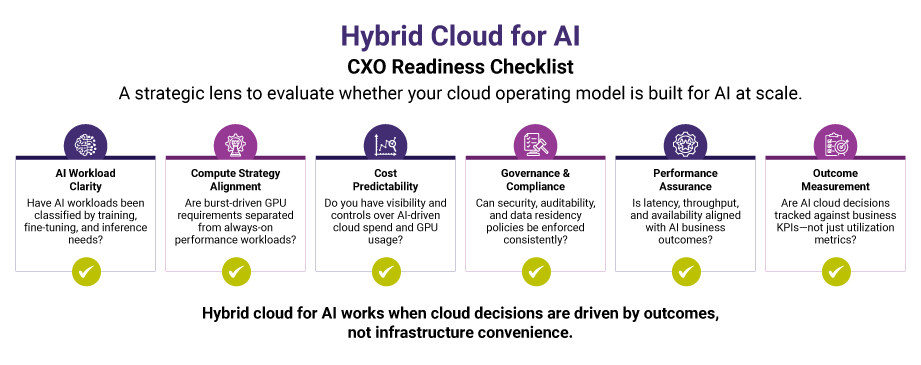
Designing a hybrid cloud for AI requires more than architectural diagrams. CXOs must ask the right questions upfront to avoid long-term operational and financial friction.
Key decision points include:
- Which AI workloads require governed cloud environments versus open experimentation?
- Which workloads need elastic compute capacity versus persistent performance?
- What controls must continuously enforce compliance, cost management, and access governance?
- How will AI cloud consumption be measured against business outcomes, not just utilization metrics?
Enterprises that may succeed with AI treat cloud consumption as a measurable business input, not an abstract technical expense.
How Sify Enables Hybrid Cloud for AI Through Cloud Services
Executing a hybrid cloud for AI strategy requires cloud services that are designed for performance, governance, and business visibility, not just infrastructure delivery.
Sify Technologies enables enterprises to operationalize hybrid cloud for AI through secure, AI-ready cloud services built for high-performance workloads and regulated environments.
Sify’s cloud services support AI-driven enterprises by offering:
- AI-ready cloud infrastructure designed for compute-intensive workloads
- Governed hybrid cloud environments aligned with regulatory, security, and data residency requirements
- Integrated GPU-as-a-Service (GPUaaS) within hybrid cloud architectures, enabling on-demand GPU access without long-term commitments
- Unified cloud management that provides visibility into cost, compliance, and performance across environments
By embedding GPUaaS within a governed hybrid cloud model, Sify allows enterprises to accelerate AI experimentation, scale workloads safely, and reduce financial risk — without fragmenting cloud operations.
For CXOs, this means AI initiatives that move faster, cost less to operate, and remain aligned with enterprise governance frameworks.
Hybrid cloud for AI is no longer an interim architecture. It is becoming the default operating model for enterprises serious about AI at scale.
By balancing cost control, regulatory confidence, and compute performance — and by partnering with cloud providers that understand AI as a business capability, not just a technical workload — CXOs can turn AI from an experiment into a sustained competitive advantage.
To learn more, speak to our experts today.