

Table of contents
Artificial intelligence is rewriting the economics of data centers.
As enterprises deploy larger models, denser GPU clusters, and always-on inference pipelines, the limiting factor is no longer access to compute alone — it is the ability to sustain that compute at peak performance, predictably and efficiently. This is where data center cooling for AI workloads has emerged as a board-level concern.
Air-cooled environments, designed for traditional enterprise IT, are now colliding with the thermal reality of AI infrastructure demand. The result is not just higher energy bills — but throttled performance, unpredictable costs, and constrained AI roadmaps.
For CXOs, cooling strategy is no longer a facilities discussion. It is a direct lever for AI outcomes.
Recommended read: AI-Ready Infrastructure: How Data Centers Are Evolving to Power AI Workloads
The Top 3 Business Outcomes Driving Liquid Cooling Adoption
Compute density ↑ | Model throughput ↑ | Energy volatility ↓
The problem, in one sentence:
Air-cooled data centers are hitting thermal ceilings that cap AI performance and quietly inflate operational risk.
Modern AI racks routinely exceed 30–40 kW, with next-generation accelerators pushing far beyond that. In air-cooled environments, these densities force compromises—lower clock speeds, uneven thermal profiles, or expensive over-provisioning of power and airflow.
Liquid cooling changes that equation. From a CXO perspective, data center cooling for AI workloads delivers three measurable business outcomes:
- Higher usable compute per rack: Liquid cooling removes heat at the source, enabling sustained high-density deployments without throttling.
- Consistent AI performance: Stable thermals mean predictable training times, inference latency, and SLO adherence.
- Reduced exposure to energy volatility: Higher cooling efficiency lowers sensitivity to power cost spikes and regulatory pressure around energy usage.
In short, enhanced technology in cooling like liquid cooling becomes a mechanism to unlock AI scale and break the constraints and limits enterprises were facing.
The CXO Decision Lens: 4 Questions That Define Cooling Strategy
Cooling decisions shape AI economics for years. The right questions help separate short-term fixes from future-proof strategies.
- What rack density must the AI roadmap support?
Today’s models are not the ceiling. Cooling architecture must support the accelerators arriving over the next one to three years — not just current deployments. - What is the cost of thermal throttling on AI performance?
Slower model training, inconsistent inference, and delayed insights all have revenue and risk implications. Cooling inefficiency shows up as lost opportunity, not just technical debt. - How does cooling efficiency affect long-term OpEx exposure?
Energy costs are now a primary driver of AI TCO. Also, because of thermal throttling, the servers run slow and not at capacity which increase the cost as everything needs to be paid for longer time. Efficient cooling directly impacts financial predictability at scale. - Can the cooling architecture scale with next-generation accelerators?
A cooling strategy that requires redesign for every hardware refresh introduces friction, downtime, and capital inefficiency.
These questions frame data center cooling for AI workloads as a strategic decision — The data center providers need to consider this from ground up and not an afterthought.
Recommended read: Data Center Sustainability Challenges: Why High Performance Comes at a Cost
Industry Outcomes: Where Liquid Cooling Directly Improves AI ROI
The impact of cooling efficiency is industry-specific — but consistently material.
BFSI: Real-time risk and fraud models
Sustained GPU clocks enable consistent inference latency, reducing risk leakage during peak transaction windows.
Retail & E-commerce: Continuous personalization retraining
Faster model cycles accelerate experimentation, improving conversion rates and revenue per user.
Manufacturing: Vision systems and digital twins
Higher compute density supports more accurate simulations and defect detection, reducing downtime and operational losses.
Telecom: AI-driven network optimization
Stable performance under peak loads improves Quality of Service, directly influencing churn reduction.
Healthcare & Pharma: Imaging and genomics
High-density compute with controlled thermals enables faster insights while maintaining strict data locality and compliance.
Across sectors, liquid cooling translates into measurable AI ROI — not just infrastructure efficiency.
Recommended read: Data Center Security and Compliance Gaps That Put AI Workloads at Risk
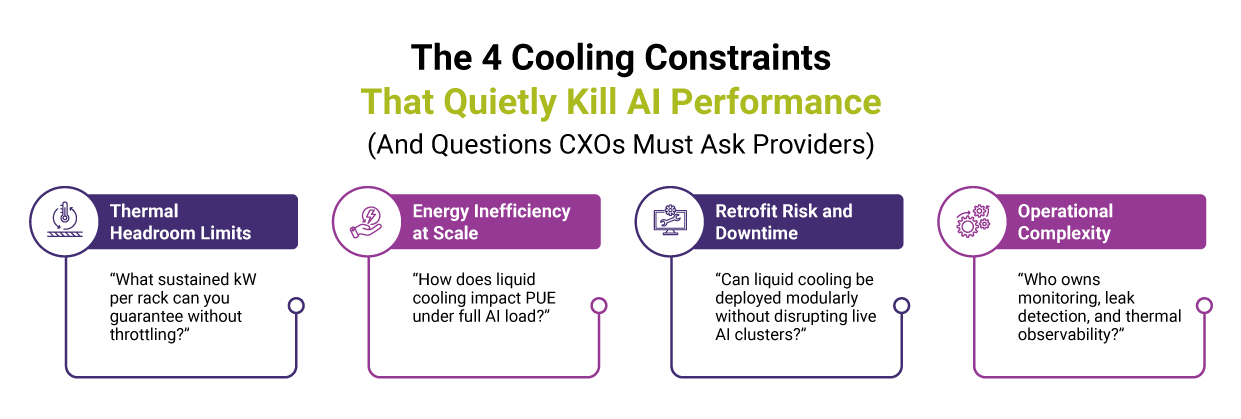
The 4 Cooling Constraints That Quietly Kill AI Performance
(And the Questions CXOs Must Ask Providers)
- Thermal headroom limits
Question: “What sustained kW per rack can you guarantee without throttling?” - Energy inefficiency at scale
Question: “How does liquid cooling impact PUE under full AI load — not theoretical averages?” - Retrofit risk and downtime
Question: “Can liquid cooling be deployed modularly without disrupting live AI clusters?” - Operational complexity
Question: “Who owns monitoring, leak detection, and thermal observability across the stack?”
These constraints often surface only after AI workloads are in production — when remediation becomes costly. Proactive design avoids reactive firefighting.
Execution Roadmap: Deploying Liquid Cooling with Predictable Outcomes
For enterprises, success lies in execution discipline — not just technology choice.
- Align AI workload profiles with rack-level thermal design
Map training, inference, and burst workloads to cooling requirements upfront. - Pilot liquid-cooled AI racks for a revenue-critical use case
Validate performance impact where business value is immediately visible. - Establish end-to-end observability
Integrate power, thermal metrics, and GPU utilization into a unified monitoring layer. - Model OpEx across the full lifecycle
Account for energy, cooling efficiency, maintenance, and upgrade cycles. - Scale with a hybrid strategy
Combine liquid-ready colocation with burst flexibility to balance performance and agility.
This approach ensures that data center cooling for AI workloads delivers predictable, defensible outcomes at scale.
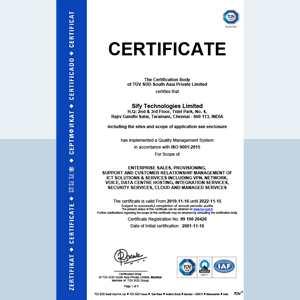
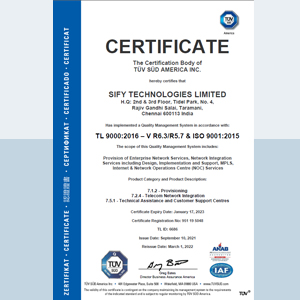
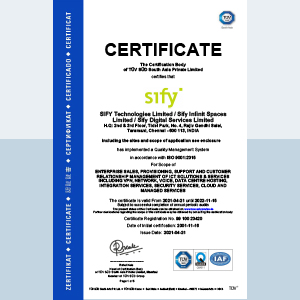
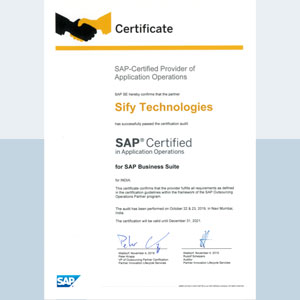
Why Sify’s NVIDIA Certified Liquid Cooling-Ready Data Center is Foundation for Enterprise AI
Enterprises need partners who design for outcomes — not just compliance checklists.
Sify data centers provide a foundation purpose-built for enterprise AI:
- AI-ready facilities engineered for high-density, liquid-cooled workloads
- Predictable thermal performance aligned to business SLAs, not best-effort cooling
- Modular scalability that supports evolving AI infrastructure without disruptive re-architecture
- An outcome-driven cooling strategy that balances performance, efficiency, and long-term cost control
As AI becomes central to competitive advantage, cooling is no longer an invisible layer of infrastructure. It is a strategic enabler of performance, resilience, and growth.
For CXOs building the next generation of AI capabilities, liquid cooling is not optional—it is foundational.
Speak to our experts today to learn more.